

Electric Spin Scrubber UN 38.3 Testing & Shipping Guide
A cordless electric spin scrubber's lithium-ion battery generally needs to be of a design that has passed the applicable UN 38.3 transport tests before commercial shipment. A passing test result is only part of the preparation. Buyers also need to confirm that the documents cover the production battery and that the shipment meets the packaging, marking and documentation rules for its route.
For an OEM order, start by matching the battery model, cell configuration and electrical specifications to the supporting test records. Resolve any differences before approving production or booking freight.
What UN 38.3 covers
UN 38.3 is subsection 38.3 of the United Nations Manual of Tests and Criteria. It sets out transport tests for lithium cells and batteries. Testing applies to a design type, so a report for one battery does not automatically cover a modified configuration.
Review three levels of the product:
- The cells must meet the requirements applicable to their use in the battery.
- A multi-cell battery pack generally needs evidence covering the assembled design, even when its cells have already passed testing.
- The finished scrubber needs suitable transport packaging and any product safety evaluations required for its market.
A single-cell battery is treated as a cell for transport purposes. Confirm how the proposed design is classified before agreeing on a test plan. 49 CFR §173.185(a)
Calculate watt-hours from confirmed specifications
Battery voltage alone does not determine transport requirements. Buyers need the nominal voltage, rated capacity, watt-hour rating and cell arrangement.
For illustration, a pack with a confirmed nominal voltage of 32.4 V and rated capacity of 2 Ah has a nominal energy of:
32.4 V × 2 Ah = 64.8 Wh
The commonly used smaller-battery thresholds of 20 Wh per lithium-ion cell and 100 Wh per lithium-ion battery can allow specified transport exceptions. They do not remove the requirement for a tested design, and eligibility depends on the other conditions of the applicable provision.
How transport testing differs from product safety testing
For U.S. transport, review 49 CFR §173.185. International air shipments use the applicable ICAO Technical Instructions and IATA Dangerous Goods Regulations. Sea shipments follow the IMDG Code.
Other standards address different aspects of safety. IEC 62133-2 covers portable rechargeable lithium cells and batteries under intended use and reasonably foreseeable misuse. UL 2595 addresses battery-powered appliance systems within its scope and is used with the relevant end-product requirements. Neither replaces UN 38.3 transport testing.
The IECEE CB Scheme supports mutual recognition of test certificates and associated reports for relevant standards. It does not provide blanket transport approval. A battery management system (BMS) is also a design feature, rather than a substitute for testing.
The eight UN 38.3 tests
The tests assess transport conditions and specified electrical or mechanical abuse. Their applicability differs: an assembled rechargeable pack is not normally subjected to all eight tests in the same way as its component cells.
| Test | What it assesses | Typical test item |
|---|---|---|
| T1: Altitude simulation | Low-pressure exposure | Cells and batteries |
| T2: Thermal test | Repeated temperature extremes | Cells and batteries |
| T3: Vibration | Vibration during transport | Cells and batteries |
| T4: Shock | Mechanical shocks | Cells and batteries |
| T5: External short circuit | Response to an external short circuit | Cells and batteries |
| T6: Impact/crush | Mechanical abuse | Cells, including relevant component cells |
| T7: Overcharge | Response to excessive charging | Rechargeable batteries |
| T8: Forced discharge | Response to forced discharge | Cells |
For T1 through T4, acceptance includes no leakage, venting, disassembly, rupture or fire, and at least 90% open-circuit-voltage retention where applicable. Fully discharged samples have an exception to the voltage criterion. The Manual's leakage assessment includes specified mass-loss limits.
T5 limits measured temperature to 170°C and prohibits disassembly, rupture and fire during the test and six-hour observation period. T6 also uses a 170°C temperature limit, with no disassembly or fire during the test and six-hour observation period. T7 and T8 require no disassembly or fire during testing and the following seven-day observation period.
These are abbreviated criteria. The laboratory must apply the full procedures, sample conditions and acceptance requirements in the edition accepted by the applicable transport rules.
What the tests tell a scrubber buyer
Motor starting loads, vibration, repeated charging and moisture exposure are relevant to a cordless cleaning appliance's design review. They also explain why transport testing should sit alongside a broader product validation plan.
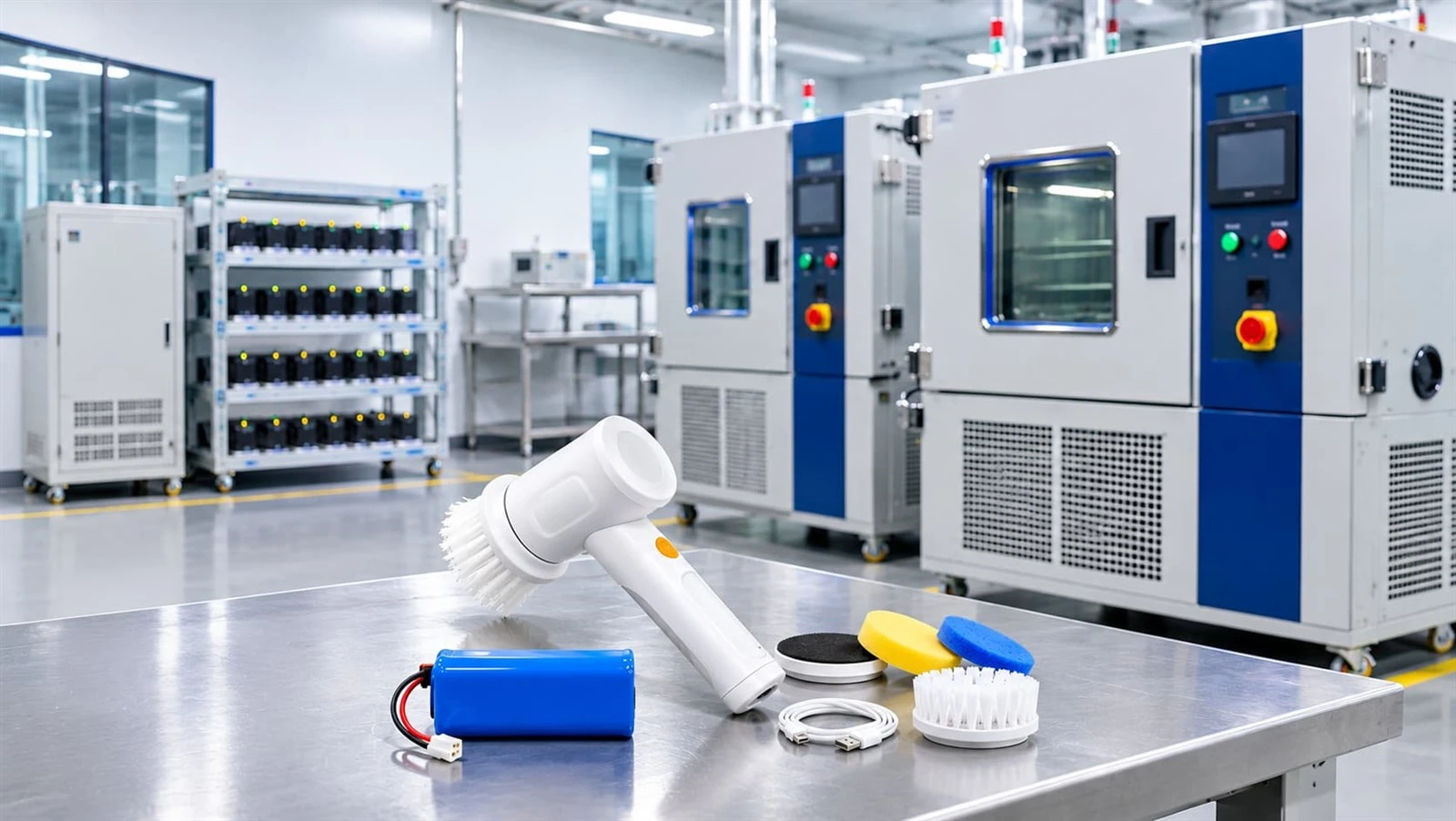
T3 and T4 can help reveal weak welds, loose connections or inadequate cell support. T5 assesses external short-circuit behavior, while T7 evaluates the rechargeable battery's response to overcharging.
A wider validation plan may cover hardware endurance, electrical safety, battery aging, corrosion resistance and cleaning scenarios. Software, app and algorithm checks apply where the product has those functions. The appropriate scope depends on the model.
A UN 38.3 pass does not establish waterproofing, cleaning performance or service life. Request separate evidence for those claims.
How many samples does testing require?
For a typical small rechargeable multi-cell battery, T1 through T5 generally use eight fully charged packs:
- Four at the first cycle.
- Four after 25 cycles, ending fully charged.
T7 generally also requires four first-cycle and four cycled, fully charged packs for this battery category. Qualifying undamaged samples from earlier testing may be reused where the procedure permits.
Component-cell testing requires a separate review. For example, rechargeable-cell T6 testing generally uses five first-cycle cells and five cells after 25 cycles, at approximately 50% of design-rated capacity.
Eight packs may cover T1 through T5, but they do not necessarily cover the complete testing program. Ask the laboratory for a sample matrix covering pack tests, component-cell evidence, cycling preparation, charge states and permitted sample reuse.
Laboratory sample charge states differ from shipping charge limits. A requirement to test fully charged samples does not authorize shipment at full charge.
How to verify a UN 38.3 report and test summary
A full test report, a test summary and a document marketed as a "UN 38.3 certificate" serve different purposes.
The full report records the test work, sample information, results and conclusions. The test summary provides standardized information that identifies the tested design and supporting report. A certificate cover page alone may not contain enough information for either purpose.
Check that the summary contains the required manufacturer and laboratory contact details, report identifier and date, battery description, mass and energy information, test results, applicable Manual edition and the responsible person's name and title. Under U.S. rules, manufacturers and subsequent distributors must make the required summary available.
For supplier approval, compare the documents against the proposed production battery:
1.Match the manufacturer, battery model, chemistry, nominal voltage, capacity, Wh rating and physical construction.
2.Verify the laboratory and report number through independently obtained contact details.
3.Check the component-cell models and suppliers against the production bill of materials.
4.Confirm that the pack configuration and protection system correspond to the tested design.
5.Resolve model aliases, specification differences and design changes with documented evidence.
A cell report alone generally does not establish compliance for a newly assembled multi-cell pack. Unexplained model changes, mismatched capacities and reports for unrelated designs also need investigation.
Report age alone does not establish whether the evidence remains valid. PHMSA states that a test summary does not require annual renewal solely because time has passed; relevant design changes and applicable regulatory provisions still matter.
Whether the battery is shipped alone, packed with the scrubber or installed in it determines the starting classification.
| Shipping configuration | UN number | IATA packing instruction |
|---|---|---|
| Battery shipped separately | UN 3480 | PI 965 |
| Battery packed with the scrubber, but not installed | UN 3481 | PI 966 |
| Battery installed inside the scrubber | UN 3481 | PI 967 |
Under PI 965, lithium-ion batteries are normally cargo-aircraft-only and must not exceed 30% state of charge (SOC).
From January 1, 2026, PI 966 Section I requires SOC at or below 30% of rated capacity. Section II applies this limit to cells and batteries above 2.7 Wh. Higher-charge shipments require approval from the State of Origin and the State of the Operator; Section II shipments must then follow Section I provisions.
For PI 967, IATA recommends SOC no greater than 30%, or indicated battery capacity no greater than 25%. This is not a general mandatory charge limit under that instruction.
Confirm the packing-instruction section, quantity limits and any state or airline variations before booking.
Sea freight, packaging and shipping documents
IMDG Code Amendment 42-24 became mandatory on January 1, 2026. Sea freight has its own classification, packaging, marking and documentation provisions.
Depending on the shipment and available exceptions, documentation can include a dangerous goods transport document and a container or vehicle packing certificate. A qualifying smaller-battery shipment may receive specified exceptions, but the shipper must verify every applicable condition.
For both air and sea shipments, packaging needs to protect against short circuits, movement, damage and accidental activation. The required battery mark, Class 9 lithium battery hazard label, cargo-aircraft-only label and other markings depend on the transport mode and applicable provision. They are not a universal set to apply to every carton.
Does an SDS replace transport documents?
Freight forwarders often request a Safety Data Sheet (SDS), still commonly called an MSDS. IATA explains that an SDS is not itself a mandatory lithium-battery transport document. It does not replace the test summary or a dangerous goods declaration where one is required.
If supplied, the SDS should agree with the battery identification, chemistry, Wh rating and transport classification in the other shipment records.
Choosing a laboratory and budgeting for testing
Review the laboratory's lithium-battery experience, equipment, reporting practices and ability to verify its reports. Where accreditation is part of your supplier criteria, check that its ISO/IEC 17025 scope covers the relevant testing activities. Accreditation is evidence of laboratory competence within its scope, rather than a guarantee that a submitted battery will pass.
Request a quotation that identifies the battery design, test scope, sample quantities, cycling preparation, reporting deliverables and treatment of failures or retesting. Battery size, preparation work, location and test scope can all affect cost. A fixed advertised price is difficult to assess without those details.
When does a battery change require retesting?
A design change needs technical assessment when it can affect UN 38.3 results. Review changes to cell chemistry or design, series/parallel arrangement, protection circuitry, safety-related software and mechanical construction.
For rechargeable cells and batteries, the Manual also identifies a change in nominal energy of more than 20%, or an increase in nominal voltage of more than 20%, as a new-type trigger. Other changes can require retesting even below those thresholds if they could materially affect the results.
A cosmetic label change alone generally does not create a new battery type. An enclosure or firmware change needs an assessment of its effect on the tested design. Keep the assessment and any revised test evidence with the production records.
An OEM buyer's approval checklist
Before placing the order
Confirm the battery manufacturer, model, cell source, electrical specifications and available test evidence. Check that the quoted battery and documented battery are the same design.
Before testing and production approval
Freeze the cell configuration, protection hardware, relevant software version and enclosure design. Agree on sample preparation and require a review of proposed substitutions.
Before shipment
Confirm the shipping configuration, classification, charge level, battery markings, test-summary availability, packaging and route-specific documents.
Production quality checks can include voltage, internal resistance, cell balance and BMS protection-function checks under controlled procedures. Use manufacturer-approved limits and retain the results. These checks help identify abnormal packs; they do not replace transport type testing.
Quarantine swollen, leaking, damaged or otherwise abnormal batteries. Have them assessed under the applicable damaged or defective battery rules before considering transport.
Discuss your electric spin scrubber project with BESTYIM
For an OEM/ODM discussion with BESTYIM, prepare the proposed battery specifications, cell configuration, available test reports, destination market, shipping method and production schedule.
Frequently asked questions
Is UN 38.3 required for an electric spin scrubber battery?
For routine commercial transport, its lithium battery generally must be of a design proven to meet the applicable UN 38.3 tests. Specific exceptions exist, including controlled provisions for certain prototypes, but should not be assumed to apply to normal production orders.
Does a 32.4 V battery pack need its own testing?
A multi-cell pack generally needs evidence for the assembled battery design. Voltage alone does not determine the test scope, and a component-cell report does not automatically cover the pack.
Does a rechargeable battery pack need all eight UN 38.3 tests?
No. UN 38.3 assesses a design type using specified samples. T6 and T8 address cells, while T7 addresses rechargeable batteries, subject to the Manual's detailed provisions. It is not a requirement to destructively test every production pack.
How can I check a supplier's UN 38.3 documents?
Verify the manufacturer, model, specifications, laboratory, report number, results and applicable Manual edition. Compare the production cell and pack configuration with the tested design, and resolve any differences before approval.
Does a battery below 100 Wh avoid UN 38.3 testing?
No. That threshold can support specified transport exceptions when all relevant conditions are met. It does not, by itself, waive the design-testing requirement.
How should battery condition be checked before shipping?
Use controlled visual, voltage, resistance, cell-balance, protection-function and temperature checks with approved limits. These checks identify abnormalities but do not establish transport compliance on their own. Segregate suspect packs for assessment.


