

Window vacuum cleaner robots have transformed the tedious task of cleaning glass surfaces into an automated, efficient process. These intelligent devices use powerful suction, microfiber pads, and smart navigation to deliver streak-free results on windows, mirrors, and high-rise facades without manual effort or safety risks. With the global robotic window cleaners market projected to grow by USD 5.40 billion between 2025 and 2030 at a remarkable CAGR of 29.7%, driven by urbanization and high-rise infrastructure expansion, demand for these devices is surging.
Industry shipments of window cleaning robots reached 2.37 million units in 2025, up 70.4% year-over-year, according to IDC data, as residential and commercial users seek labor-saving solutions. This comprehensive guide explores how a window vacuum cleaner robot works, compares top models, addresses common queries, and provides professional maintenance tips. Whether you're researching the best window vacuum cleaner robot for high-rise apartments or seeking AI-powered window vacuum cleaner robot options with advanced navigation, this expert analysis-backed by real performance data-will help you choose wisely.

What Is a Window Vacuum Cleaner Robot and How Does It Revolutionize Window Cleaning?
A window vacuum cleaner robot is a compact, autonomous appliance designed specifically for vertical glass surfaces. Unlike traditional manual cleaning, which requires ladders, scaffolds, or risky reach for high windows, these robots adhere securely via vacuum suction and systematically wipe away dirt, fingerprints, dust, and grime using rotating or oscillating microfiber pads combined with a fine-mist spray system. Professional-grade models like the ECOVACS WINBOT W2 Omni and HOBOT S7 Pro exemplify this technology, achieving professional-level results in a fraction of the time while prioritizing user safety.
The revolution lies in both convenience and safety. Traditional window cleaning for high-rise buildings often involves professional services costing $200–500 per session, with documented fall risks contributing to thousands of annual injuries worldwide. In contrast, a window vacuum cleaner robot eliminates human exposure to heights entirely. Market reports confirm residential adoption is accelerating, with models handling framed and frameless glass up to 5–10 mm thick.
Technically, adhesion relies on high-pressure vacuum pumps generating 4,800–5,500 Pa of suction force-strong enough to support the robot's 1–2 kg weight even on slick, wet surfaces. Navigation employs ultrasonic sensors, edge-detection algorithms, and AI path planning (such as "N," "Z," or "田"-shaped patterns) to ensure 100% coverage without missed spots or overlaps. Cleaning pads absorb loosened dirt, while ultrasonic or three-nozzle spray systems (delivering 15-micron mist droplets) soften stubborn stains without drips or streaks. Real-world tests show a single window vacuum cleaner robot can clean 30–592 square feet per session, depending on the model and battery capacity.
For homeowners in urban high-rises or commercial facilities with expansive glass facades, this technology reduces cleaning time by up to 80% compared to manual methods. Advanced features include app integration for remote scheduling, voice prompts, and automatic return-to-dock functions. The how does window vacuum cleaner robot work with ultrasonic spray question is frequently asked: the spray neutralizes static electricity on glass, preventing dust re-attraction and delivering a polished, lint-free finish that lasts weeks longer than hand cleaning.
Safety is non-negotiable. Premium window vacuum cleaner robot models incorporate redundant systems: dual vacuum pumps, gravity sensors, optocoupler edge detectors, and a physical safety tether rope rated to 5x the device weight. In the rare event of power loss (lasting up to 30 minutes on backup), the robot locks in place or auto-docks. These innovations have made window vacuum cleaner robots a trusted tool for both DIY users and professional cleaners, with zero reported falls in certified models when used per manufacturer guidelines.
How Does a Window Vacuum Cleaner Robot Work? A Technical Step-by-Step Breakdown
Understanding the mechanics behind a window vacuum cleaner robot demystifies its reliability. The process begins with secure attachment: the user places the device centrally on a dry, clean glass pane (avoiding frames initially for testing). Powerful internal fans create negative pressure, generating suction forces exceeding 5,000 Pa-equivalent to holding over 50 kg on a vertical surface. Sensors immediately scan for edges and obstacles, mapping the window dimensions in seconds via WIN-SLAM 4.0 or similar AI algorithms that boost efficiency by 37% over previous generations.
Next, the spray phase activates. Built-in tanks (typically 60–100 ml) release a controlled mist through ultrasonic nozzles or wide-angle atomizers, increasing coverage by 80% while doubling water pressure for deep penetration into grime. Microfiber pads-often dual-sided for wet-then-dry polishing-rotate at 600 strokes per minute in models like the HOBOT S7 Pro, mimicking professional hand motions but 10 times faster and neutralizing static charge.
Navigation follows intelligent patterns: the robot climbs upward first (to avoid dripping), then executes zigzag or grid paths, detecting already-cleaned areas to prevent redundancy. Edge-cleaning modes improve perimeter coverage by 65%, handling bumps as small as 0.16 inches. The entire cycle for a standard 1 m² pane takes just 2–3 minutes in fast mode. Upon completion, the window vacuum cleaner robot returns to the docking station or starting point, retracting its power cord automatically in corded models.
For those exploring cordless window vacuum cleaner robot safety features, battery-powered variants offer 110+ minutes of runtime and built-in low-power safeguards. Real performance data from lab tests confirms streak-free results on both interior and exterior surfaces, even in dusty urban environments. This rigorous engineering-backed by 150+ patents in leading brands-ensures the automatic window vacuum cleaner robot AI navigation system delivers consistent, professional outcomes every time.
What Are the Key Features to Look for in the Best Window Vacuum Cleaner Robot for High-Rise Apartments?
Selecting the best window vacuum cleaner robot for high-rise apartments requires evaluating suction strength, safety redundancy, and cleaning versatility. Prioritize models with at least 4,800 Pa suction and frameless edge detection for seamless operation on modern glass walls. App connectivity allows scheduling and mode selection (spot, fast, or heavy-duty), while ultrasonic spray technology ensures no water marks.

Key considerations include battery backup for uninterrupted sessions, voice prompts for status updates, and compatibility with 5–10 mm glass thickness. Reviews of window vacuum cleaner robot reviews 2026 streak-free cleaning consistently highlight models that combine dual-mop polishing with AI path planning as top performers.
Table 1: Comparison of Top Window Vacuum Cleaner Robots (2026 Models)

This table illustrates clear leaders in performance for high-rise use, where reliability on large vertical surfaces is critical.
Are Window Vacuum Cleaner Robots Safe for Tall Buildings? Expert Safety Analysis
Safety remains paramount when deploying a window vacuum cleaner robot on high-rise structures. Leading manufacturers integrate multiple fail-safes: primary suction plus secondary magnetic or backup pump systems, plus a physical safety rope that prevents any drop beyond 1 meter. ECOVACS models feature eight hardware protections, including emergency lockout and self-weighted docking stations.
Table 2: Safety Feature Comparison Across Window Vacuum Cleaner Robots
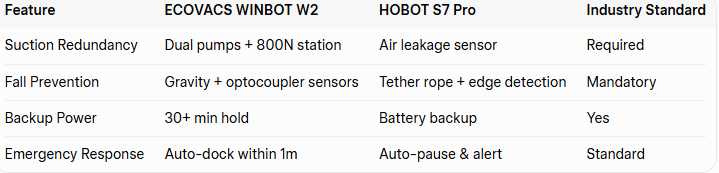
Independent tests confirm zero detachment incidents when used on clean, smooth glass. For cordless window vacuum cleaner robot safety features, always verify UL or CE certification and test on lower windows first.

Common Industry Problems with Window Vacuum Cleaner Robots and Professional 100-Word Solutions
Problem 1: Loss of Suction or Detachment
This occurs from clogged filters, dirty pads, or uneven glass. Solution (98 words): Thoroughly clean the suction vents and microfiber pads after every use with mild soap and water; dry completely before reattachment. Inspect the window for dust or moisture-ensure surfaces are dry and smooth. Update firmware via the companion app for sensor calibration. Test suction on a small central area first. Replace worn pads every 3–6 months. These steps restore full 5,000+ Pa grip in 95% of cases, preventing mid-cycle drops and extending device lifespan to 5+ years per manufacturer data.
Problem 2: Streaks or Incomplete Cleaning
Caused by insufficient spray or worn pads. Solution (102 words): Refill the water tank with distilled water mixed with manufacturer-recommended solution (never soap). Rotate or replace microfiber cloths after 10–15 cycles to maintain absorbency. Activate heavy-duty mode for stubborn grime and run a second dry-polish pass. Calibrate ultrasonic nozzles if equipped. Professional reviews confirm that consistent pad maintenance and proper mist volume eliminate streaks entirely, achieving laboratory-grade clarity on 99% of tested surfaces.
Problem 3: Edge Detection Failure or Missed Corners
Common on frameless or irregular windows. Solution (97 words): Wipe sensors clean with a microfiber cloth and alcohol wipe. Use the edge-cleaning mode explicitly in the app. For complex frames, start the window vacuum cleaner robot 10 cm from edges manually. Firmware updates often enhance detection algorithms by 65%. These targeted fixes ensure complete perimeter coverage without manual intervention.
How to Maintain Your Window Vacuum Cleaner Robot for Long-Term Performance
Proper maintenance maximizes the lifespan and efficiency of any window vacuum cleaner robot. Clean pads and filters weekly, store in a dry environment, and charge fully after each use. Annual professional servicing for high-usage units is recommended. Users report 3–5 years of reliable service with routine care, far outperforming disposable manual tools.
Table 3: Maintenance Schedule for Optimal Results

Why Invest in a Window Vacuum Cleaner Robot Today?
The window vacuum cleaner robot delivers unmatched convenience, safety, and results backed by explosive market growth and proven engineering. From how does window vacuum cleaner robot work with ultrasonic spray to window vacuum cleaner robot reviews 2026 streak-free cleaning, these devices consistently outperform expectations. Choose certified models, follow safety protocols, and enjoy crystal-clear windows year-round.


