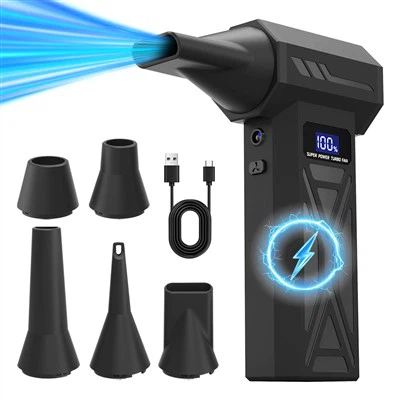
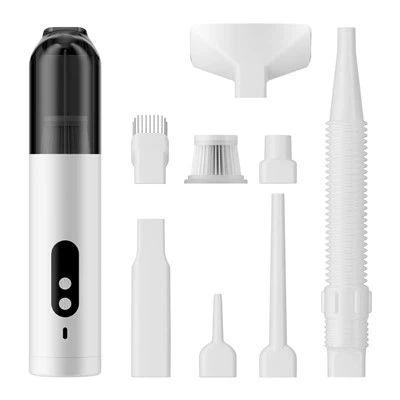
As a supplier of Portable Turbo Fans, I'm often asked about the speed adjustment mechanism of these innovative devices. In this blog post, I'll delve into the details of how these mechanisms work, the different types available, and their benefits.
Understanding the Basics of a Portable Turbo Fan
Before we dive into the speed adjustment mechanism, let's briefly understand what a Portable Turbo Fan is. A Portable Turbo Fan is a compact, high - performance fan that uses a turbocharger - like design to generate a powerful and concentrated airflow. These fans are popular for their portability, energy efficiency, and ability to provide strong ventilation in various settings, such as homes, offices, and workshops.
The Importance of Speed Adjustment
Speed adjustment is a crucial feature in Portable Turbo Fans as it allows users to customize the airflow according to their specific needs. Whether you need a gentle breeze for a comfortable sleep or a high - speed blast to quickly cool down a hot room, the ability to adjust the fan speed gives you greater control over the environment.
Types of Speed Adjustment Mechanisms
1. Manual Speed Control
One of the most common speed adjustment mechanisms in Portable Turbo Fans is manual speed control. This type of mechanism typically consists of a simple dial or switch on the fan's control panel. By turning the dial or flipping the switch, users can select from a range of pre - set speeds.
Manual speed control is straightforward and easy to use. It doesn't require any complex programming or additional equipment. For example, a user can simply turn the dial clockwise to increase the fan speed and counter - clockwise to decrease it. This type of control is ideal for users who prefer a hands - on approach and want to quickly adjust the fan speed based on their immediate needs.


2. Remote - Controlled Speed Adjustment
In recent years, many Portable Turbo Fans have been equipped with remote - controlled speed adjustment. This mechanism uses a wireless remote control that communicates with the fan via infrared or radio frequency signals.
The advantage of remote - controlled speed adjustment is convenience. Users can adjust the fan speed from across the room without having to get up and reach the fan's control panel. This is especially useful when you're sitting on the couch, in bed, or working at a desk. For instance, you can lie in bed and use the remote to turn up the fan speed if you start to feel hot during the night.
3. Digital Speed Control
Digital speed control is a more advanced speed adjustment mechanism. These fans are equipped with a digital display and a set of buttons that allow users to precisely set the fan speed. Some digital - controlled fans even offer a wide range of speed settings, not just a few pre - set options.
With digital speed control, users can input a specific speed value, often in terms of revolutions per minute (RPM). This level of precision is beneficial for applications where a specific airflow rate is required, such as in a laboratory or a server room. Additionally, digital speed control can be integrated with other features like timers and sleep modes, providing a more comprehensive user experience.
How the Speed Adjustment Mechanisms Work
Electrical Resistance and Voltage Regulation
In most Portable Turbo Fans, the speed adjustment is achieved through electrical resistance and voltage regulation. When you adjust the speed using a manual or digital control, you're essentially changing the amount of electrical resistance in the fan's motor circuit.
According to Ohm's Law (V = IR, where V is voltage, I is current, and R is resistance), by increasing the resistance, the current flowing through the motor decreases. Since the power output of the motor (P = VI) is related to the current and voltage, a decrease in current results in a lower power output and a slower fan speed. Conversely, decreasing the resistance increases the current and the fan speed.
Pulse Width Modulation (PWM)
Some high - end Portable Turbo Fans use Pulse Width Modulation (PWM) for speed adjustment. PWM is a technique where the power supplied to the motor is switched on and off at a high frequency. The ratio of the on - time to the off - time (duty cycle) determines the average power delivered to the motor.
For example, if the duty cycle is 50%, the motor receives power for half of the time and is off for the other half. A higher duty cycle means more power is delivered to the motor, resulting in a higher fan speed. PWM offers more precise control over the fan speed compared to traditional resistance - based methods and is also more energy - efficient.
Benefits of Different Speed Adjustment Mechanisms
Energy Efficiency
One of the significant benefits of having a speed adjustment mechanism is energy efficiency. By being able to adjust the fan speed according to your needs, you can avoid running the fan at full speed all the time. For instance, if you only need a gentle breeze, you can set the fan to a lower speed, which consumes less energy. This not only saves electricity but also reduces your energy bills in the long run.
Customized Comfort
Speed adjustment allows for customized comfort. Different people have different preferences when it comes to airflow. Some may like a strong, fast - moving airflow, while others prefer a more gentle and subtle breeze. With the ability to adjust the fan speed, each user can create a personalized and comfortable environment.
Noise Reduction
Running a fan at a lower speed generally produces less noise. If you're using the fan in a quiet environment, such as a bedroom or a library, you can set the fan to a lower speed to minimize the noise. This is especially important for those who are sensitive to noise or need a quiet space to sleep or work.
Our Product Range
At our company, we offer a variety of Portable Turbo Fans with different speed adjustment mechanisms to meet the diverse needs of our customers.
We have the Small Turbo Jet Fan, which is a compact and powerful fan with manual speed control. It's perfect for small spaces like dorm rooms or home offices.
Our Super Power Turbo Jet Fan comes with a remote - controlled speed adjustment feature. This fan is ideal for larger rooms where you need a powerful airflow and the convenience of adjusting the speed from a distance.
If you're looking for a more advanced option, our Small Turbo Fan is equipped with digital speed control. You can precisely set the fan speed and enjoy additional features like timers and sleep modes.
Contact Us for Purchase and Negotiation
If you're interested in our Portable Turbo Fans and would like to discuss a purchase, we're here to help. Our team of experts can provide you with detailed information about our products, including specifications, pricing, and delivery options. Whether you're a retailer looking to stock our fans or an end - user in need of a reliable ventilation solution, we're ready to work with you. Contact us today to start the negotiation process and find the perfect Portable Turbo Fan for your needs.
References
- "Fundamentals of Electric Circuits" by Charles K. Alexander and Matthew N. O. Sadiku
- "Fan Engineering: The Application of Air Moving Equipment" by the American Society of Heating, Refrigerating and Air - Conditioning Engineers (ASHRAE)